


1. Update your menu in seconds
A supplier who can't deliver scallops this Friday. A new special the chef wants to test at lunch. A pricing error the head waiter spots at 11:45. With a printed menu, each of these turns into a small crisis: crossings-out, sticky notes, or worse — an expensive reprint.
With a digital menu, you edit, you publish, and it's done. The guest who scans the QR code at 12:02 already sees the corrected version. No more stress, no more "sorry sir, the tartare is off today" after the guest has already chosen it.
2. Handle allergens the way the law requires
EU Regulation 1169/2011 on food information to consumers requires you to declare the 14 major allergens for every dish. On paper, that usually means a separate binder, a spreadsheet the guest has to ask a server for, or — let's be honest — nothing at all.
With a digital menu, every dish carries its allergen icons. Guests filter for themselves (gluten-free, dairy-free, nut-free). You're compliant with no extra effort, and guests with allergies can sort things out on their own. Everyone wins.
"Since we went digital, I get zero allergen questions in the dining room. Guests filter for themselves." — Camille, chef-owner, brasserie in Bordeaux
3. Cut your printing costs
A restaurant that changes its menu four times a year spends on average between 400 and 1,200 euros on printing (quality paper, layout, delivery, damaged copies). That's before counting the hours spent going back and forth with the printer. Over five years, that's a four-figure line item gone.
For the full numbers, see our article on what a printed menu really costs you over a year.
4. Serve your guests in their own language
France welcomes over 100 million foreign visitors a year. And yet in most neighbourhood restaurants, the menu is still French only. The result: guests ordering blind, frustration, and a lower average spend.
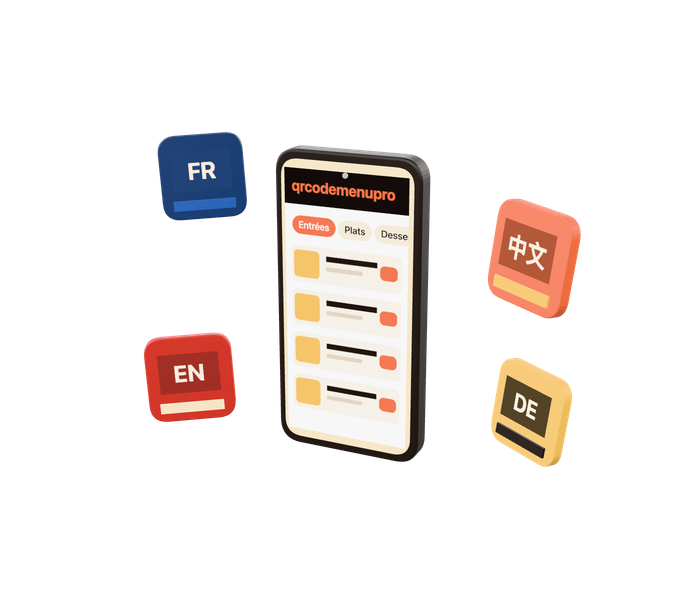
A digital menu automatically offers an English, Spanish, German, Italian, Dutch, Chinese or Japanese version. Visitors read it, understand it, order with confidence — and often pick a more expensive dish.
5. Shrink your environmental footprint
It gets discussed less than the other reasons, but it weighs more and more heavily in restaurateurs' decisions. A full-colour, laminated menu reprinted every quarter means:
- Coated paper that's hard to recycle (plastic layer)
- Solvent-based inks
- Road deliveries between the printer and your restaurant
- A lot of waste whenever the menu changes before the stock runs out
A QR code printed on a small kraft card, plus a digital menu, cuts that footprint by a factor of 20 to 50 depending on how you use it.
6. See what your guests are actually looking at
A printed menu is a black box: you have no idea which dish gets the most attention, which one gets skipped over, what time guests look at the menu, or which language they use.
A digital menu records all of that anonymously. You discover that your "duck breast" is the most-viewed dish but the least ordered: maybe it's priced too high, or the description isn't selling it. Those numbers then feed your menu engineering strategy.
7. Keep up with your legal obligations
Beyond allergens, the obligations stack up: prices shown inclusive of tax, "homemade" labelling, meat origin, sustainably sourced fish, calorie information in certain formats. A digital menu updates in one click whenever the rules change — paper means a full reprint.
Key takeaways
- Instant updates: change something in seconds, visible to every guest straight away
- Automatic allergen compliance with Regulation 1169/2011 thanks to built-in filters
- Printing savings: €400 to €1,200 a year back in your pocket
- Languages built in: visitors better served, average spend up
- Smaller environmental footprint (paper and transport)
- Viewing statistics: you finally know what your guests are looking at
- Regulatory changes handled without a reprint